Status:Live

Rustcoach

AI Rust coach: you write the code, it runs cargo test and clippy, then reviews like a PR.

Built on
Claude, by Anthropic
Runs in
The browser, nothing to install
Price
Free start, $49 Course, top-ups
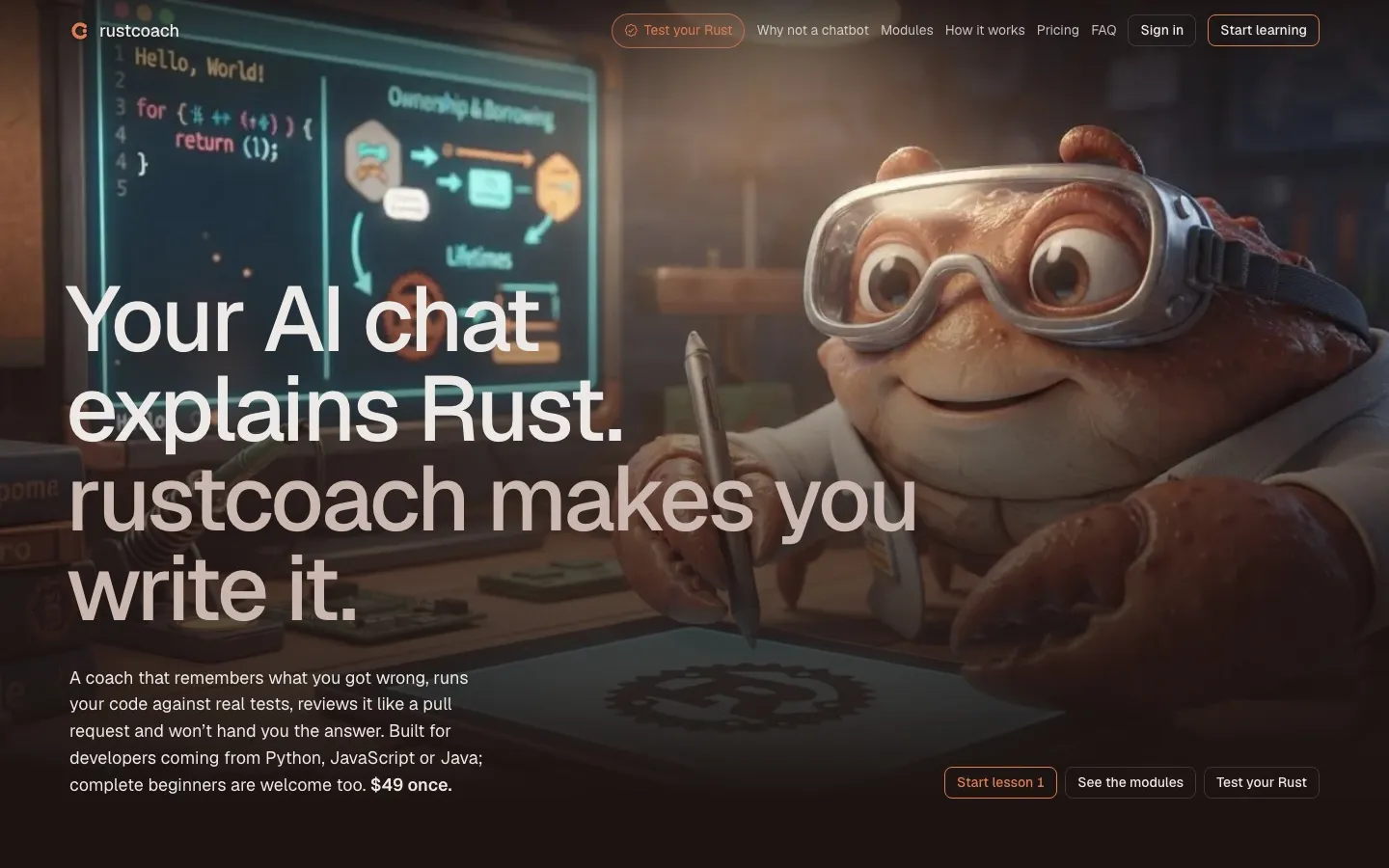
The rustcoach.dev home page: “Your AI chat explains Rust. rustcoach makes you write it.”
rustcoach.dev, captured 20 Oct 2026.

The problem

An AI chat explains Rust well. What it cannot do is everything around the explanation: it does not remember what you got wrong three lessons ago, nothing holds your code to a test suite, and it writes the fix the moment you ask for it. You end up reading Rust instead of writing it.

How it works

How a Rustcoach lesson runs, from teaching to sign-off
  1. Teach: One idea, with examples you can run
  2. Quick check: One question every few explanations
  3. Assignment: You write every line in the browser editor
  4. cargo test: Plus clippy, run in a sandbox
  5. Review: Read like a pull request, fix and resubmit
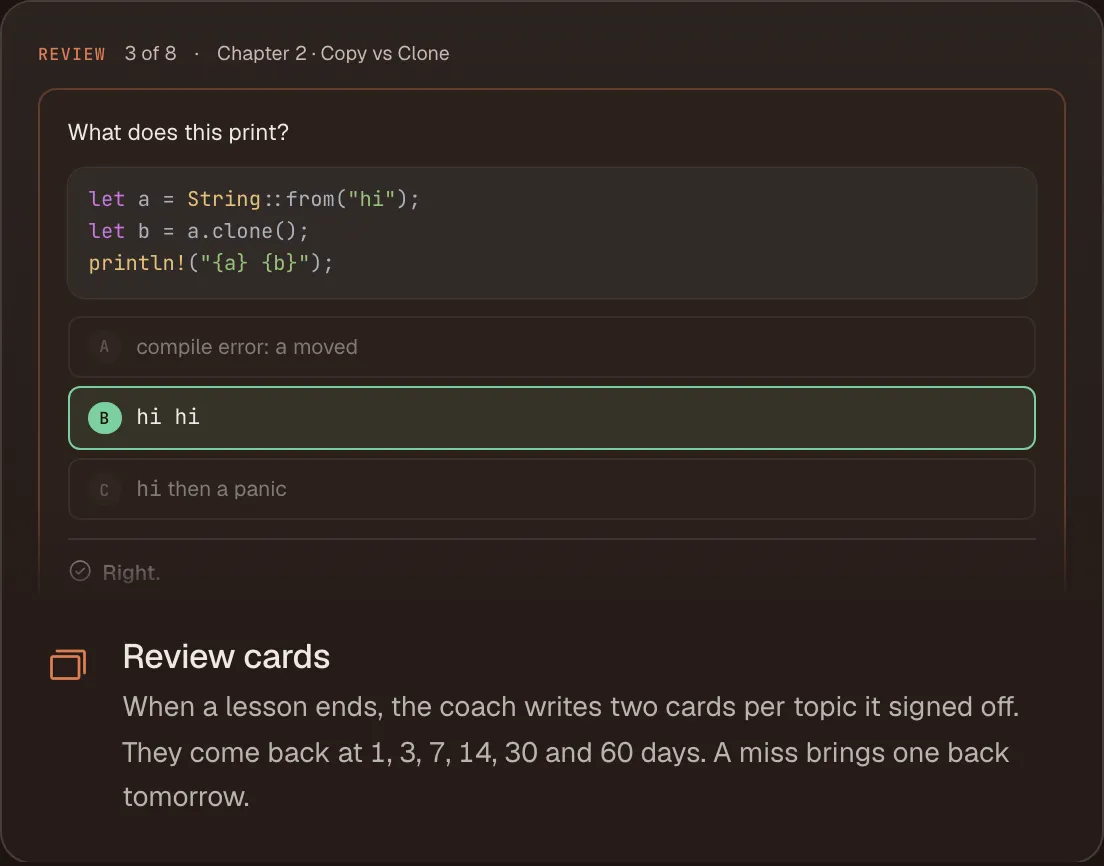
  6. Signed off: Review cards return at 1, 3, 7, 14, 30, 60 days

What it does

Lessons written for you
There is no lesson 7 that everyone gets. The coach reads its notes on you, re-tests what you got wrong last time, then teaches one idea with examples you can run.
Real tests, real clippy
Every lesson ends with an assignment you write in the browser editor. Your code is compiled and run against real tests in a sandbox, and every test run also runs clippy.
Reviewed like a pull request
Passing tests is where review starts: no stray unwrap, combinators over nested match, clippy clean, cargo fmt applied. You fix it until it is signed off.
Hints, never the answer
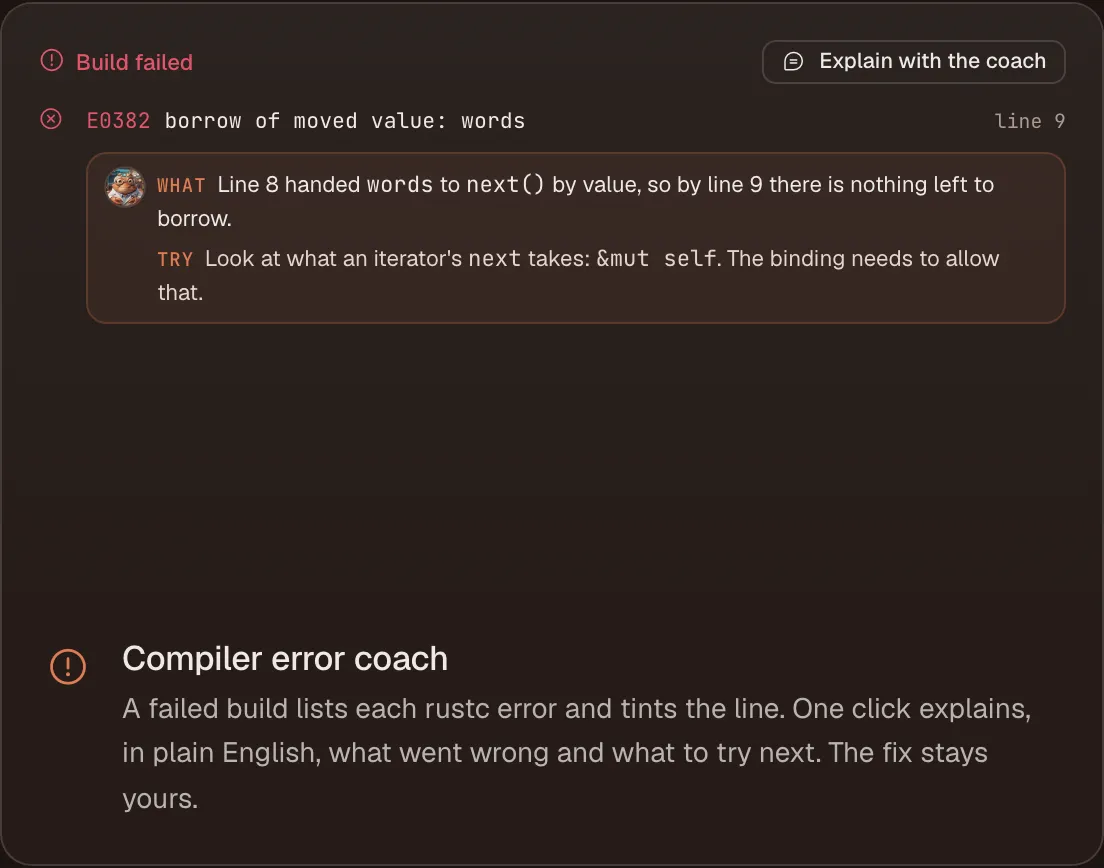
Hints point at the API to reach for, and a trace steps through your function line by line. One click on a failed build explains each rustc error in plain English. The fix stays yours.
Quick checks and review cards
Every few explanations the coach asks one question. When a lesson ends it writes review cards that come back at 1, 3, 7, 14, 30 and 60 days.
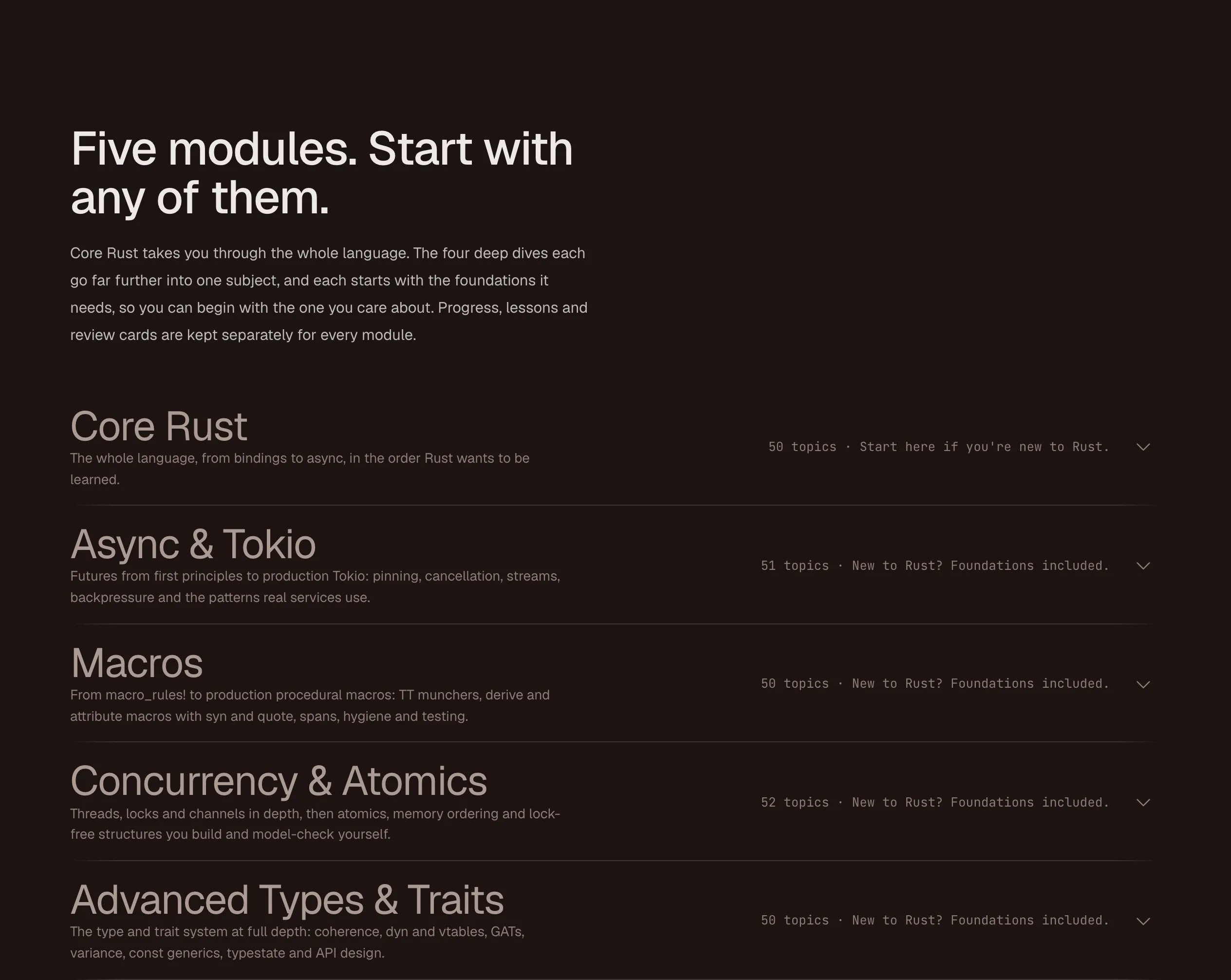
Five modules
Core Rust takes you through the whole language. Four deep dives go further into Async and Tokio, Macros, Concurrency and Atomics, and Advanced Types and Traits.
Built on Claude, and more than a chat

The coach’s replies come from Claude, by Anthropic. Everything around them is Rustcoach: a sandbox that compiles your code and runs real cargo test and clippy, a syllabus per module with mastery per topic, notes on you that carry from lesson to lesson, spaced review cards, and a coach that will not write your solution, even when you ask.

It is built for developers coming from Python, JavaScript or Java. Complete beginners are welcome too: the coach starts further back and goes slower.

Pricing

Buy it like a book. There is no subscription: you buy credits once and they never expire. A typical lesson uses about one credit.

Price Credits
Free start $0 No card needed
The Course $49 once 50, a typical learner through one full module
Top-up $10 or $25 10 for $10; 30 for $25 once you own the Course

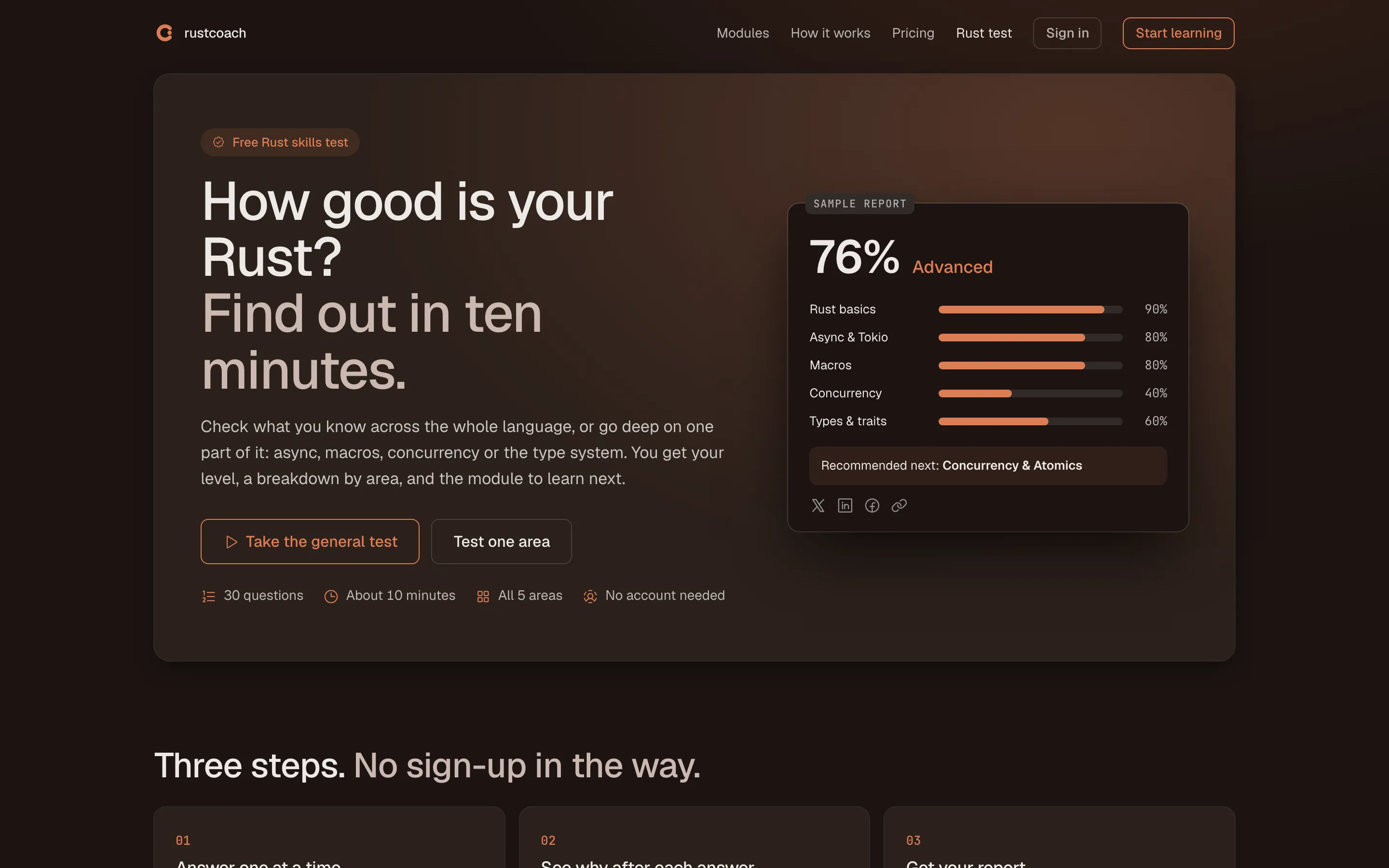
Not sure where to start? The free Rust skills test takes about ten minutes, needs no account, and ends with your level and the module that fits you best.

Writing about Rustcoach

The Rustcoach module list: Core Rust, Async & Tokio, Macros, Concurrency & Atomics, Advanced Types & Traits
Rustcoach

Rustcoach: five modules, from Core Rust to the deep dives

Rustcoach is no longer one syllabus. Core Rust now sits next to four deep-dive modules, Async & Tokio, Macros, Concurrency & Atomics and Advanced Types & Traits, each with its own syllabus, progress and review cards.