Introducing Ramzes: one endpoint for your services' notifications
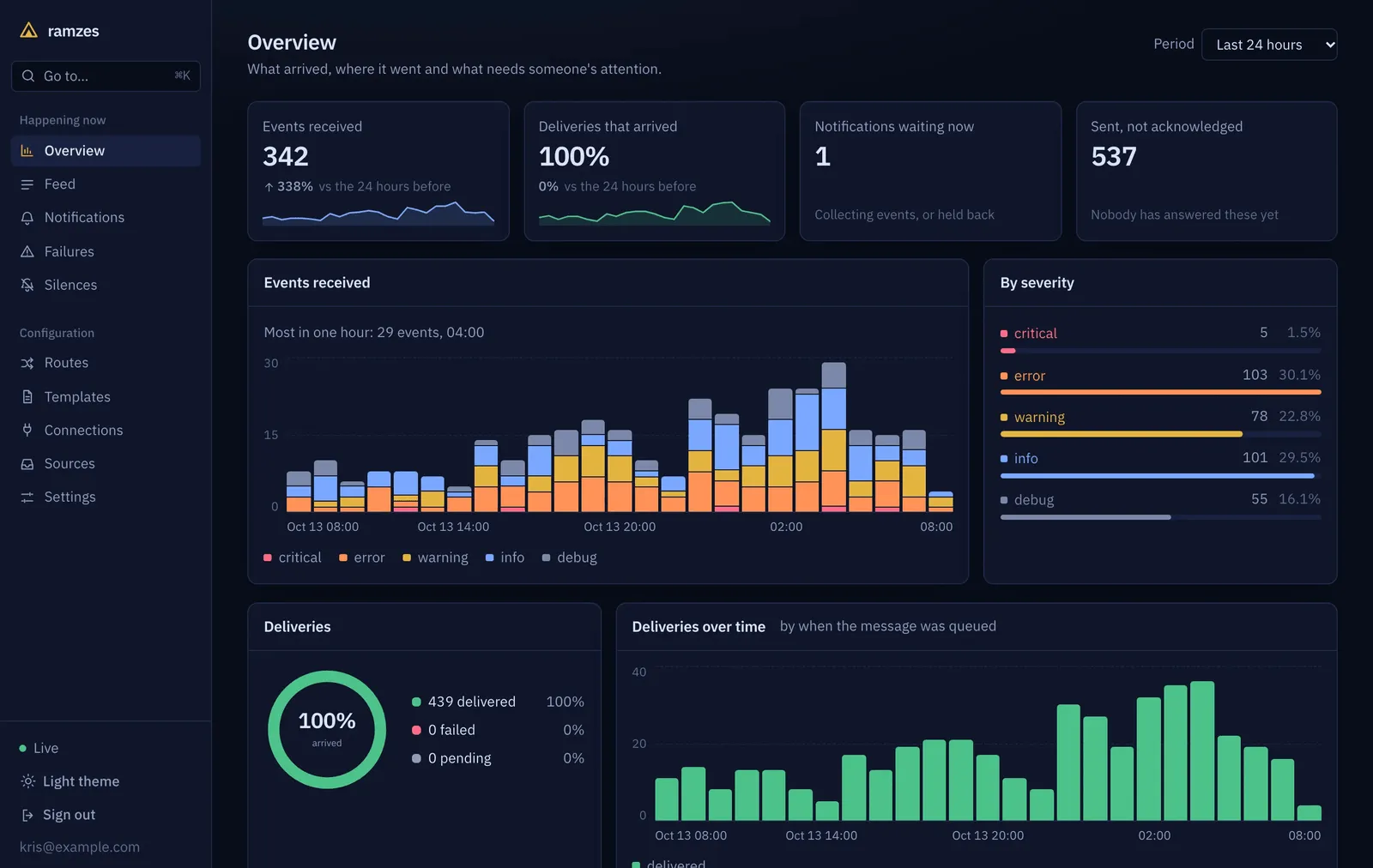
Ramzes is a self-hosted notification router written in Rust. Services send events to one endpoint; routes decide who is told, where and how often. Built and tested, not released yet.
Self-hosted notification router: one endpoint, routes decide who is told, where and how often.
Every service, monitor and pipeline sends its own alerts to its own channel. The same failure is repeated, a burst arrives as a flood, a message goes out in the middle of quiet hours, and when nobody acknowledges it, nothing else happens. Afterwards, nobody can say who was told what.
git clone https://github.com/softberries/ramzes.git && cd ramzes
docker compose -f deploy/compose.yaml up --buildYour services send events to one HTTP endpoint and get 202 once the event is stored. Routes
decide who is told, on which channel and how often: duplicates are counted instead of repeated,
bursts are grouped into one message, and messages can wait out quiet hours. For every event the
UI shows which routes matched and what each delivery attempt answered.
All of the design is built and tested, but nothing is released yet, and no channel or source has been run against its live service: request formats follow each service’s documentation and are pinned by tests. There is no published image, so Ramzes is built from a checkout.
What is not built: several instances working together, roles, single sign-on and an audit log. The documentation lists every limit that is fixed in the code.
Ramzes is a self-hosted notification router written in Rust. Services send events to one endpoint; routes decide who is told, where and how often. Built and tested, not released yet.