Rustcoach: a free Rust skills test, checked by the compiler
Rustcoach now has a free, public Rust skills test. Thirty questions in about ten minutes, no account, every code question run through the real compiler, and a report with your level and the module to take next.
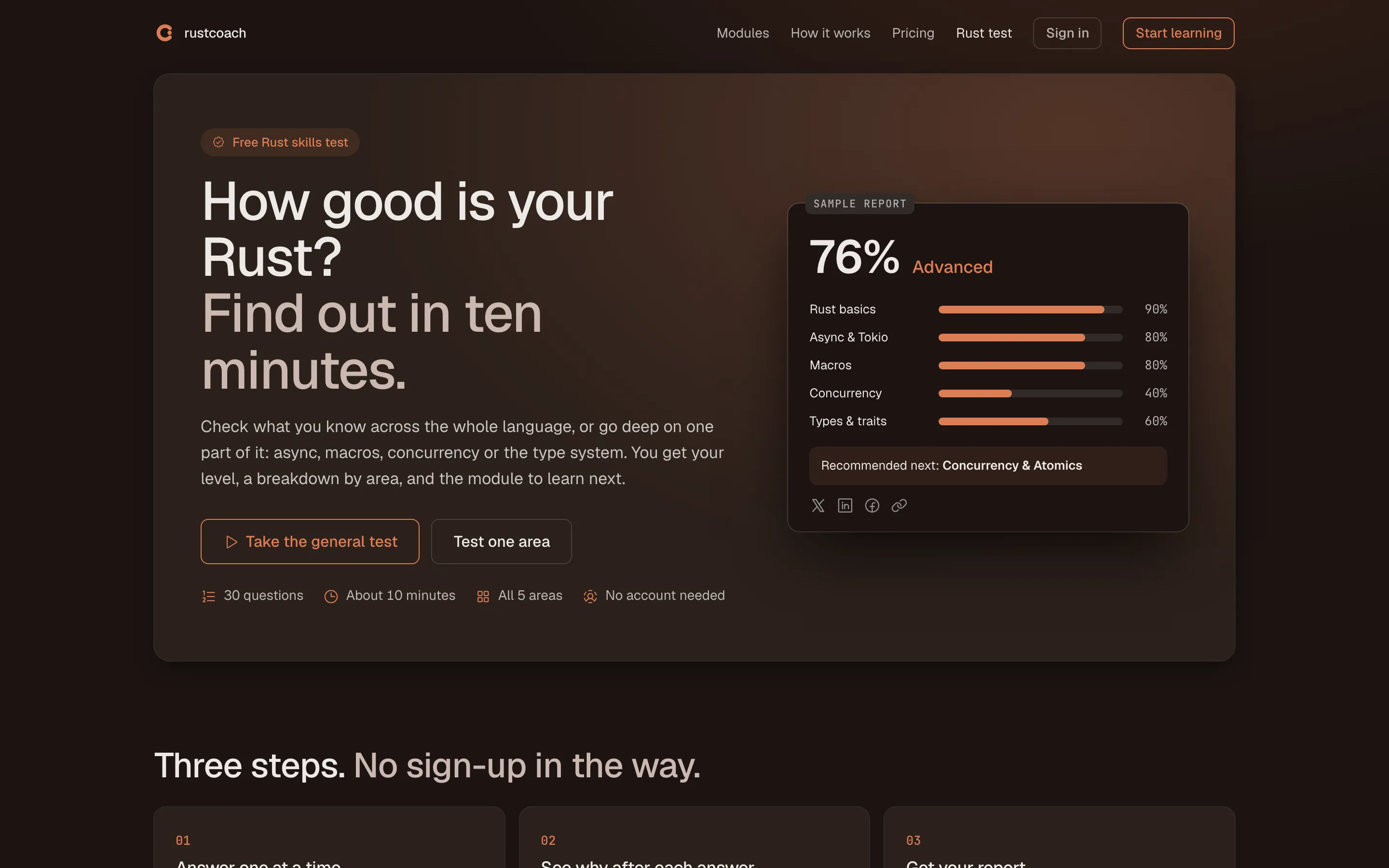
Since 11 October Rustcoach has a free Rust skills test. It takes about ten minutes, needs no account, and ends with your level, a breakdown by area, and the Rustcoach module that fits you best.
Why a test
Two days earlier Rustcoach went from one syllabus to five modules: Core Rust and four deep dives into async, macros, concurrency and the type system. With five to choose from, the natural question is which one to take.
“Start with Core if you are new to Rust” covers beginners. For everyone else the test answers the question from their own answers, and it is free whether or not they ever sign up.
What you take
There are two kinds of test.
- The general test. 30 questions, about 10 minutes, sampling all five areas. Take it if you are not sure where you stand; it recommends where to go next.
- One area. 20 questions, about 7 minutes, drawn from one Rustcoach module: Rust basics, Async & Tokio, Macros, Concurrency & Atomics, or Advanced Types & Traits. The deep-dive tests start with a few questions on the foundations they build on, then go straight to the hard parts.
Which one to take? The general test if you are not sure: it samples every area and recommends where to go next. Rust basics if you are new to Rust. A deep-dive test if you already know which area you want to check. Each has its own address: core, async, macros, concurrency and types.
The questions are real Rust: what a snippet prints, whether it compiles, why the borrow checker objects. They are multiple choice with four options, and you answer one at a time.
Why the result means something
A multiple-choice test about a compiler is only as good as its answer key. Four things are there to keep it honest:
- Checked by the compiler. Every code question was run through the real Rust compiler. The marked answer is what rustc actually does.
- Shuffled every time. Answer options are shuffled for every test, so positions cannot be learned.
- A new set each attempt. You can retake it as often as you like; each attempt draws a new random set of questions.
- Explained, not just marked. Right or wrong, you get a short explanation before the next question, so the test teaches while it measures.
The report
At the end you get a report: your level, a bar for every area, your strongest and weakest topics, the module to take next, and a link to share.
The level comes from your score, in four bands: Beginner, Intermediate, Advanced and Expert. The sample report on the test’s start page shows what that looks like: an Advanced result, strong on Rust basics, weakest on concurrency, with Concurrency & Atomics recommended next.
The shared link shows only the summary: the score, the level, a bar per area and the recommended module. It shows no name or email. Your strongest and weakest topics, and the questions with your answers, are shown only to you. Results are stored without your name, email or IP address. If you save a result to an account and later delete the account, the result is detached from it and the shared link keeps working.
From the test to the coach
If you sign up afterwards, you can save the result to your account. If you choose, the coach can use it to pick where your first lessons start. That is opt-in, with your consent, and you can withdraw it at any time with the toggle on the result page.
Try it
Take the test. Thirty questions, about ten minutes, no account.