Rustcoach: quick checks, spaced review cards and mastery
Rustcoach lessons now stop every few explanations for a quick check, signed-off topics come back as review cards at 1, 3, 7, 14, 30 and 60 days, and mastery tracks what actually stuck.
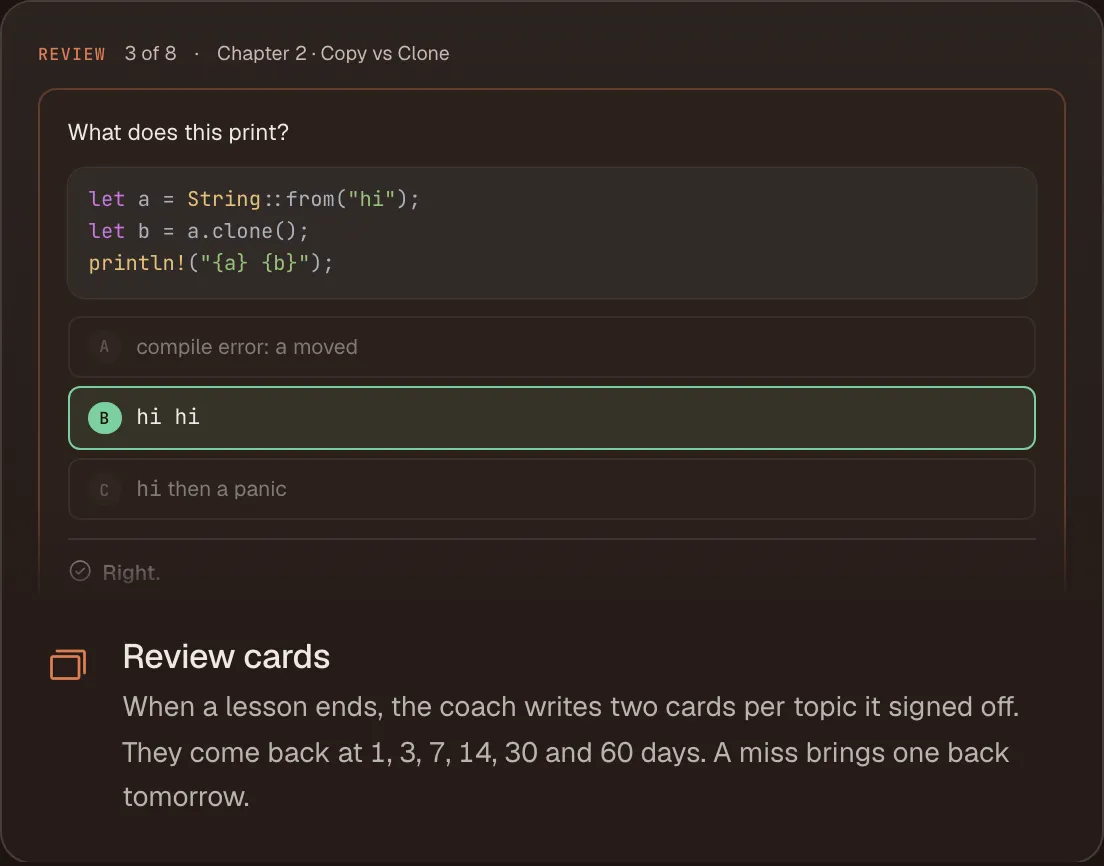
Getting through a lesson and still knowing the material a month later are two different things. A coach that only measures the first one will sign you off on topics you have already started to forget.
Rustcoach already had the core of a lesson: the coach writes it for you, sets an assignment you code in the browser, and runs your tests in a sandbox. What it did not have was a way to check, during the lesson and long after it, whether the idea stuck. That is what landed on 20 September: quick checks during the lesson, spaced review cards, and mastery with streaks.
Quick checks
Every few explanations the coach now stops and asks one question. You click an answer, see why it is right or wrong, and the lesson picks up from your answer.
That last part is the point. A quick check is not a quiz bolted onto the end of a chapter. Rustcoach lessons have no fixed script (there is no lesson 7 that everyone gets), so the answer to a quick check feeds straight into what the coach explains next.
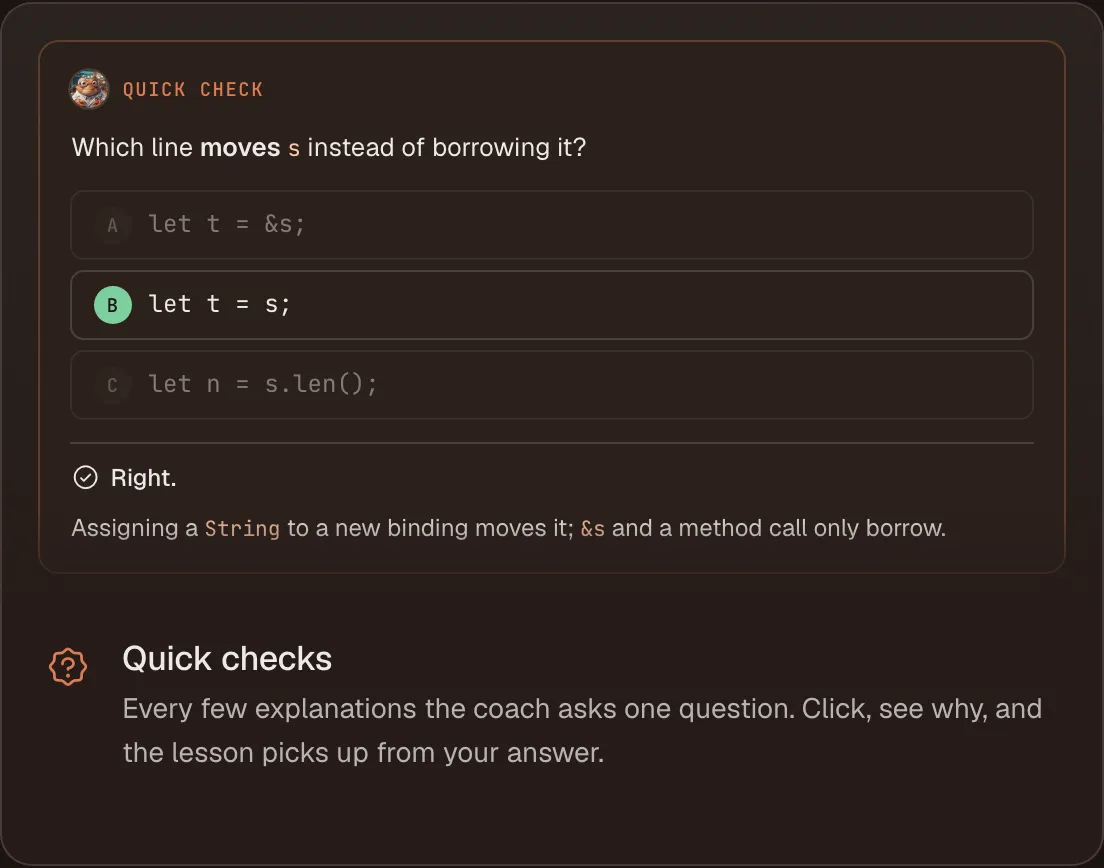 A quick check: one question, then the why.
Spaced review cards
When a lesson ends, the coach writes two review cards for each topic it signed off. They are written from the lesson you just had, not drawn from a shared deck.
The cards come back at 1, 3, 7, 14, 30 and 60 days. A miss brings that card back tomorrow.
This is spaced repetition: you see a topic again at growing intervals, and a miss shortens the interval. The difference from a general flashcard app is that the cards come from the coach that taught you, about the lesson you had.
Mastery and streaks
Every topic on the syllabus now has a mastery level. It rises with sign-offs and right answers, and falls with wrong ones.
That makes “done” mean something. In Rustcoach nothing is marked done until it sticks. The coach keeps notes on what stuck and what did not, so the next lesson starts from there, and before teaching anything new it re-tests what you got wrong last time. A day later, on 21 September, redo landed too: a shaky topic can come back as a redo of the lesson.
Streaks count the days you put in. A day counts when you chat with the coach, run tests or answer a review card, so a day spent only on review cards still counts.
How the three fit together
Each of these depends on the others:
- quick checks give the coach evidence during a lesson;
- review cards give it evidence days and weeks later;
- mastery is where that evidence adds up, per topic, on the syllabus.
Without the cards, mastery would only measure how a lesson went on the day. Without mastery, the cards would be a flashcard deck with no visible effect on your progress. Together they turn the syllabus from a list of topics into a record of what you can actually do.
What the coach’s notes look like
The Rustcoach home page shows examples of the notes the coach keeps per topic. One reads, in part: “Answered all three check questions; needed one correction on Copy vs Drop.” Another: “Passed all 9 tests first try. Re-test that he picks &mut [T] when the length is unchanged.” That second note is the kind of thing a review card, and the next lesson, comes back to.
Try it
Rustcoach runs in the browser; there is nothing to install. Start at rustcoach.dev.